 Peekabout
Peekabout
Peekabout
Turn "I don't want to go for a walk" into "Can we do another scavenger hunt, Dad?"
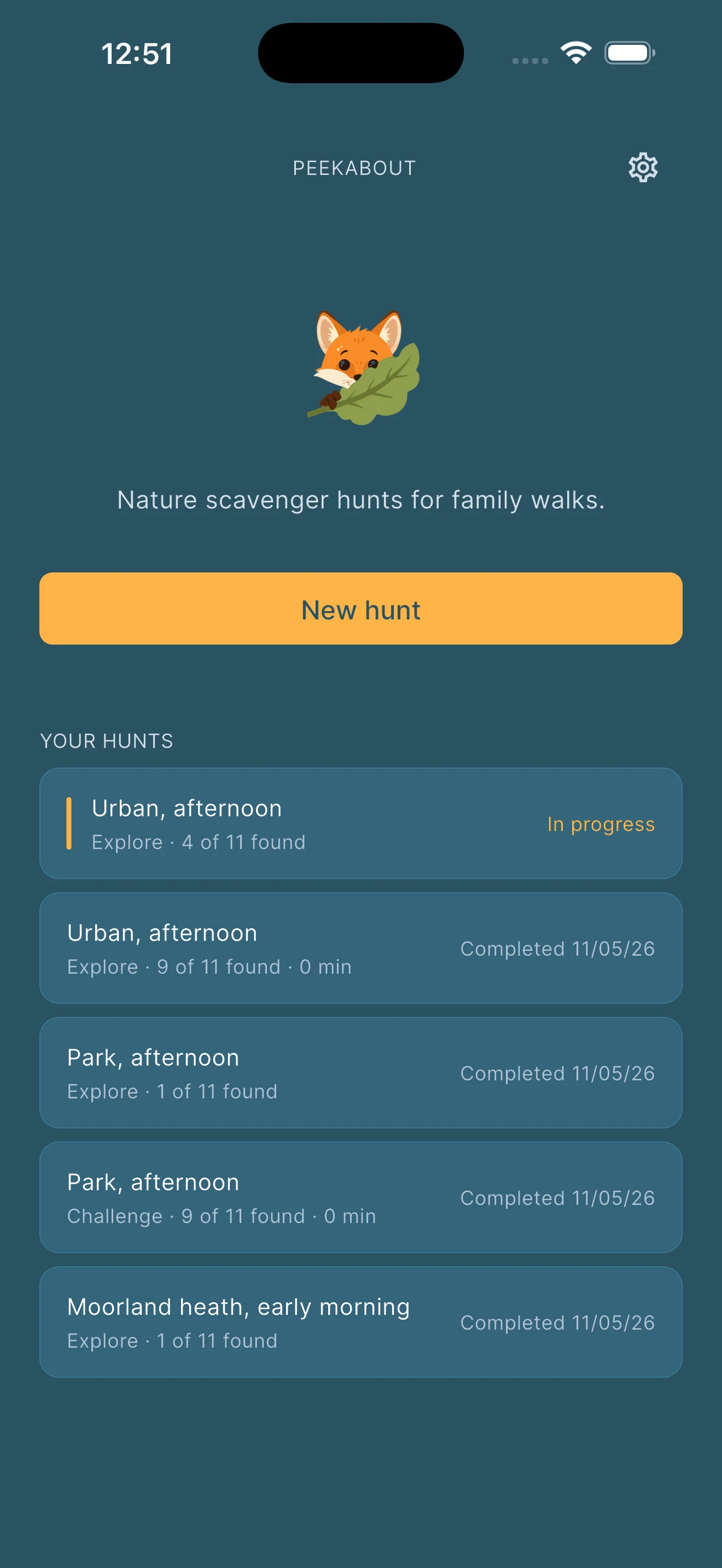
Getting small people out the door is the hard bit. Peekabout generates a fresh scavenger hunt for every family walk, adapted to where you are, the weather, and your kids' ages. An acorn in October, a ladybird on a railing in June, a robin on a rooftop next Tuesday.
Try a free hunt in your browser →Instant. Works on any phone. Live right now.
Pay once. Always yours, always private, always ready to open.
The hunt the kids haven't stopped talking about
Tell it where you're going. It'll meet you there.

Race it. Or dawdle it. Same hunt, either way.
The kind of win that makes a kid's day
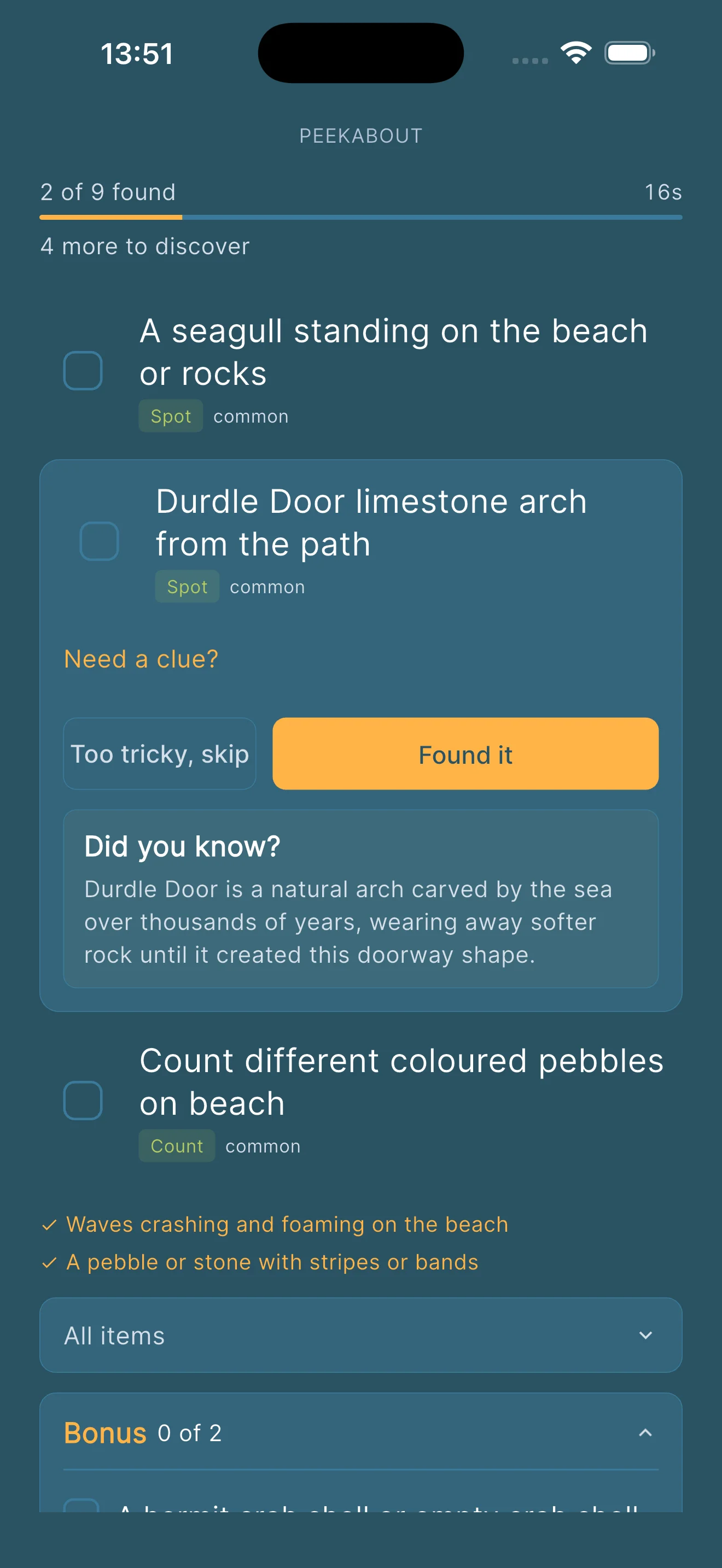
When they ask "why?", you'll have something worth saying
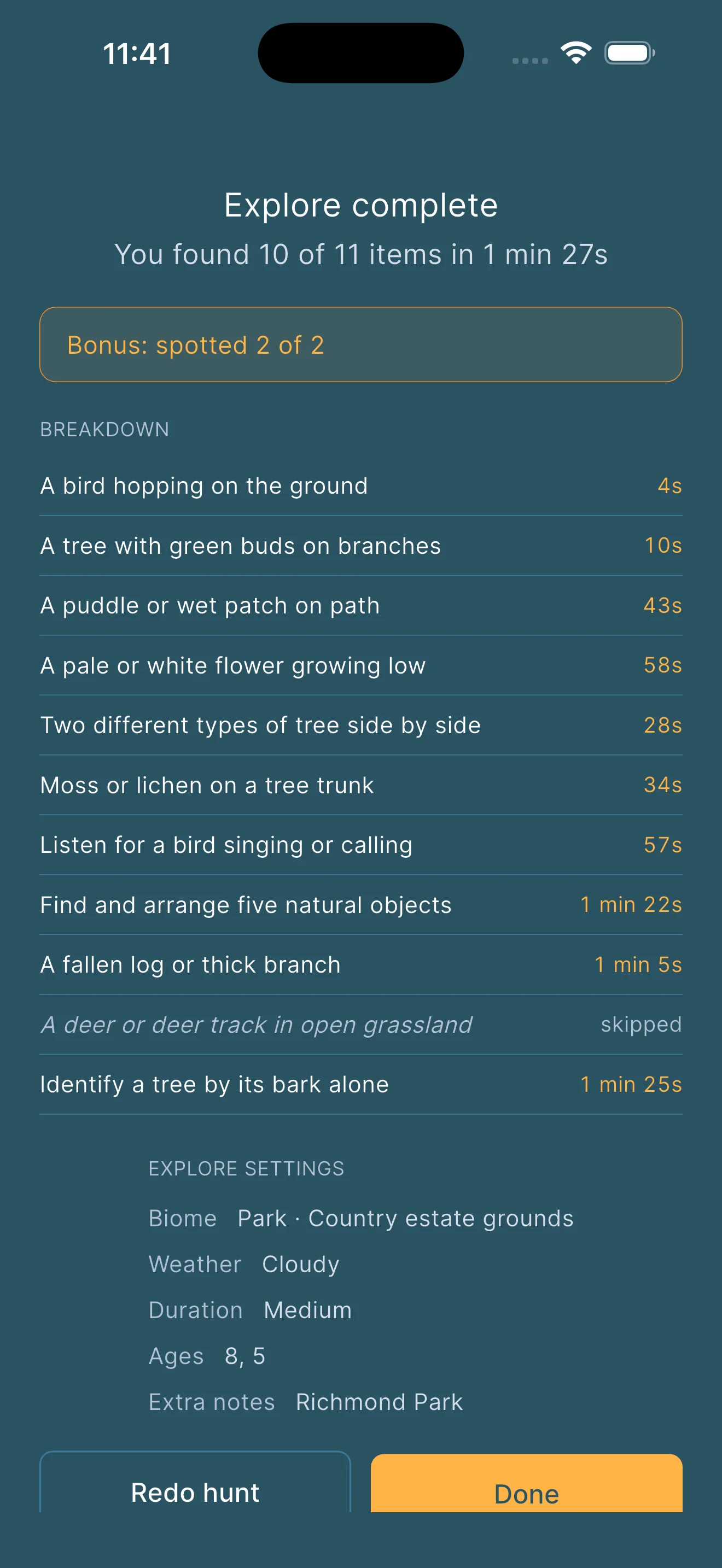
Look what we found today
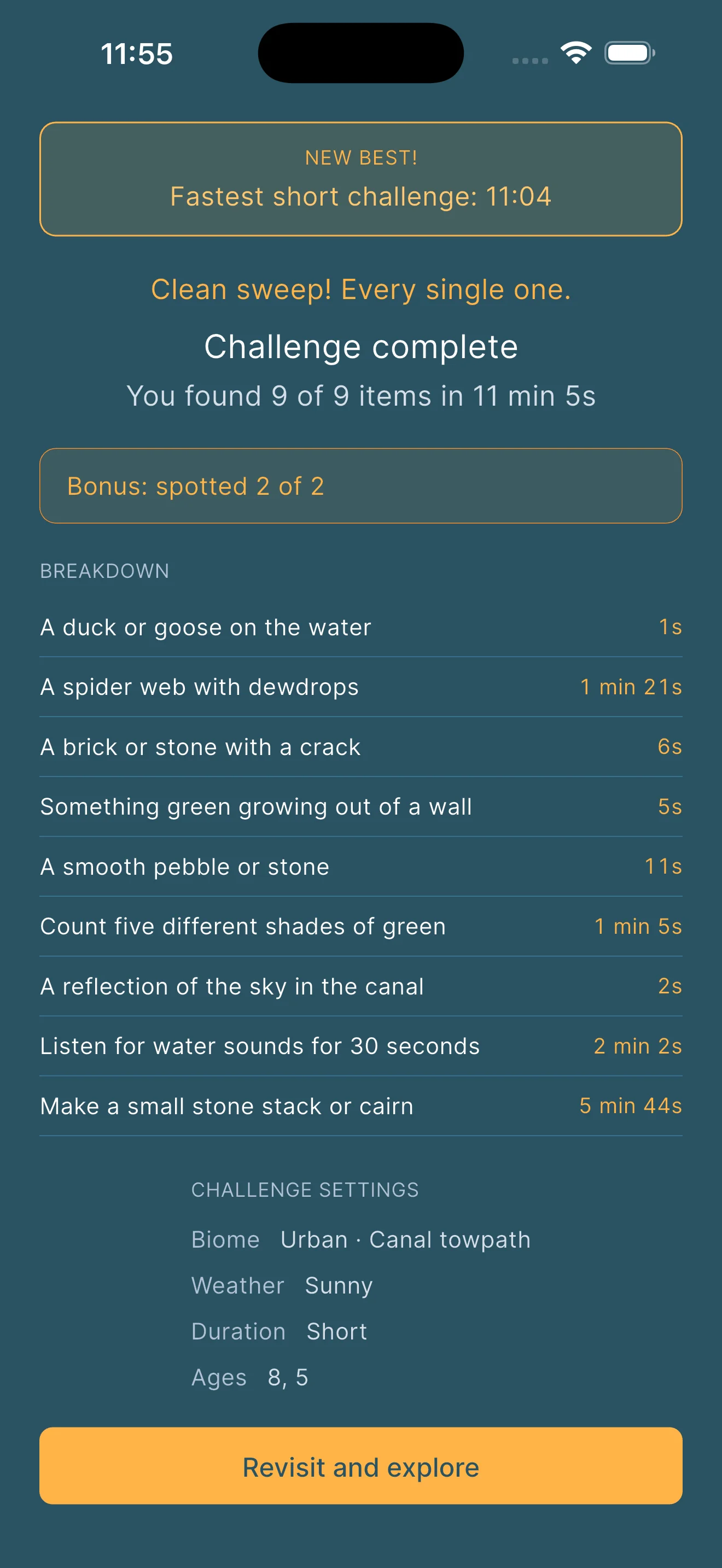
Big kids race. Little ones wander. Same trail, both win.
Three taps, then the rest happens outside.
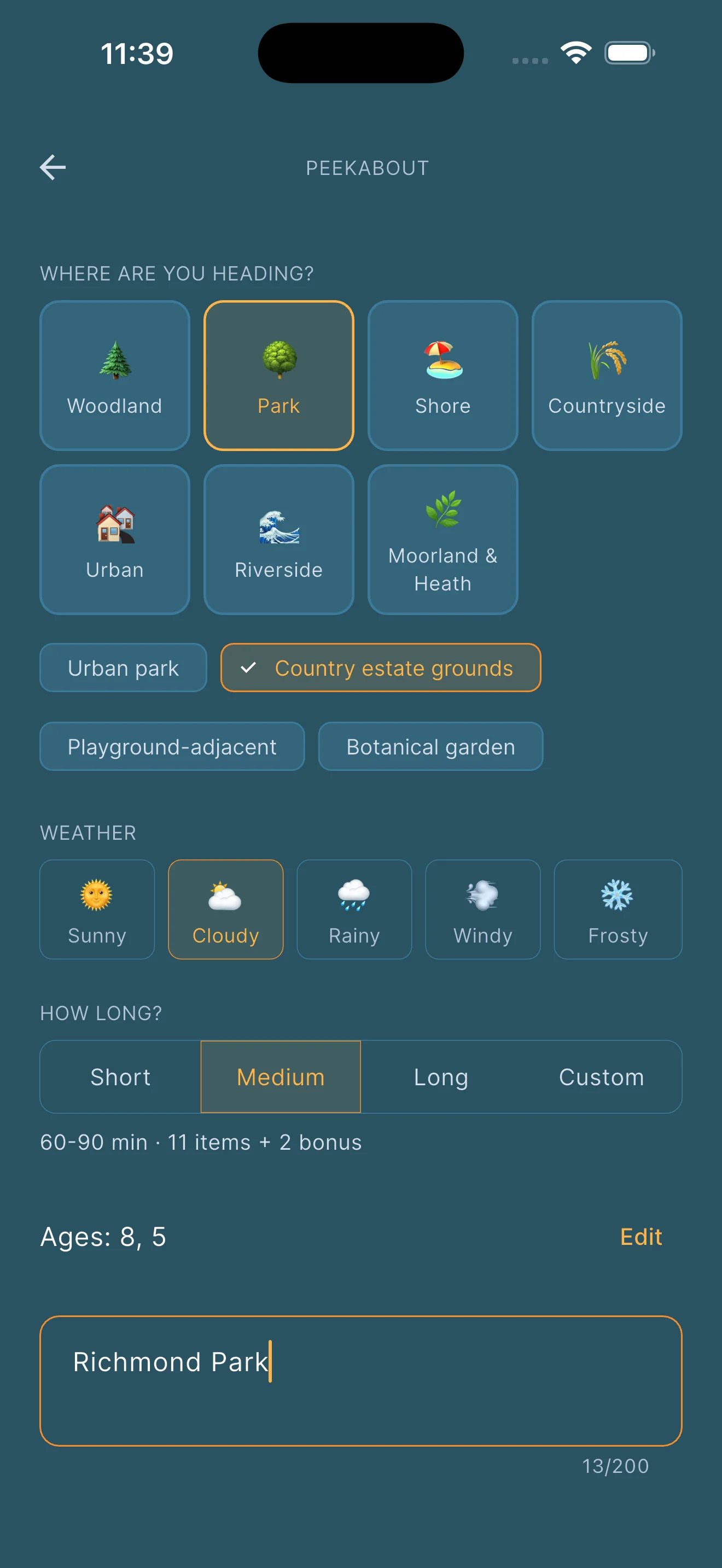
Tell Peekabout where you are, what the sky's doing, and who's coming along. About ten seconds.
Your hunt's ready in seconds and the kids are suddenly on a mission. They do the looking; you hold the phone, reading clues when they get stuck and logging each find together.
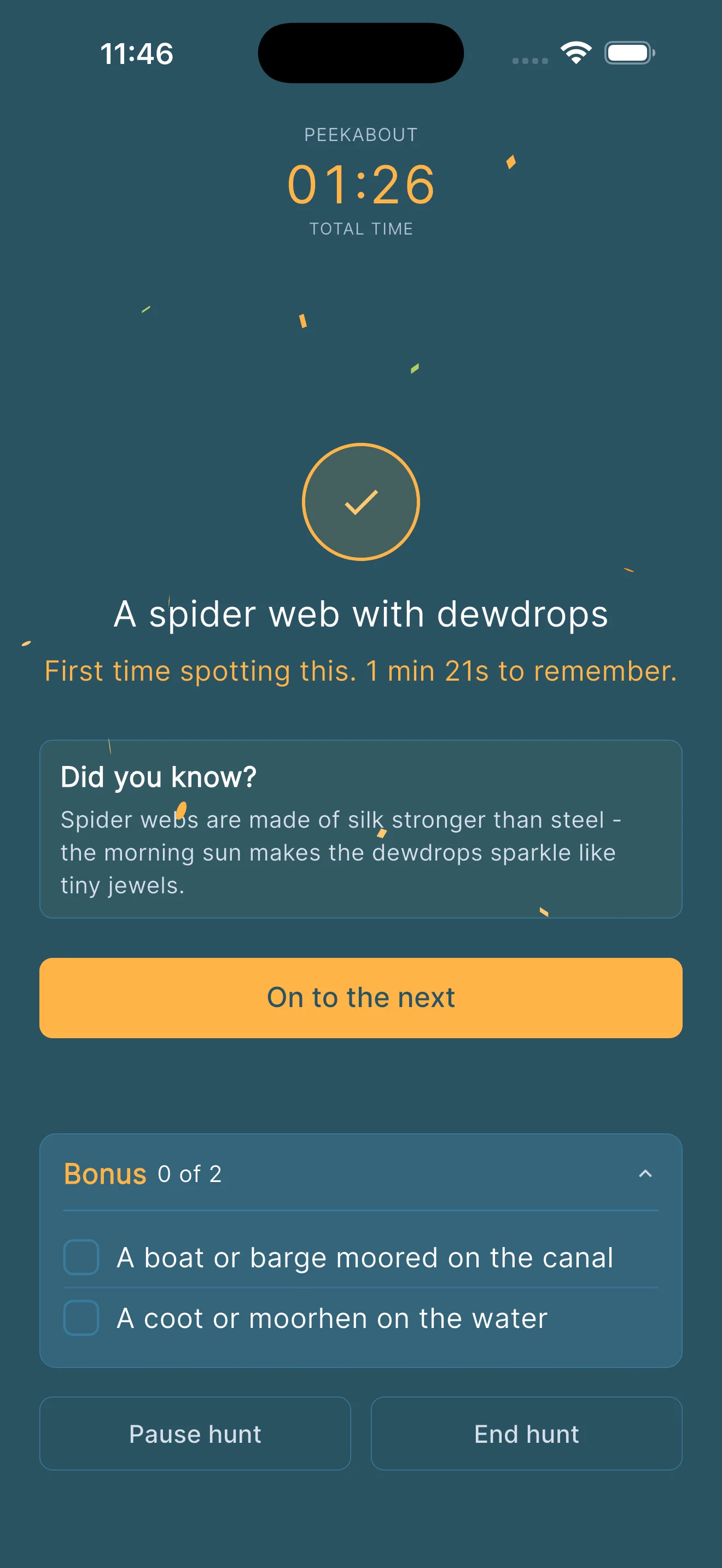
Kids spot things you'd both normally walk straight past. Every find comes with a "did you know?" moment that turns a mushroom into a conversation.



Great for getting outdoors
So much fun and gave us a good reason to head outside, even in the rain. Love all the different combinations of hunts it can pull together and really liked that it can all be personalised for each walk, especially the different age groups. Definitely recommend!
Makes any walk enjoyable
Keeps him engaged and encourages us to explore the nature around us, be it a big trip out to the forest or beach, or just a quick walk to the play area.
Great for getting outside
Sparked the imagination of my 6, 10 and 12 year old whilst passing special time together on a staycation in Dorset, UK!
New weather, new season, new hunt. Walk your usual loop and your kids are hunting for things they've never looked for before, like the first yellow leaf of fall, a robin in winter, or a bumblebee on clover in summer, even on a route they know by heart.
Tap start before you leave, then drive to the middle of nowhere. The New Forest, a Lake District fell, most of rural Wales. Peekabout loads the whole hunt before you lose signal, so the remote bits of the map are exactly where it feels best.
Tap the icon, pick a hunt, ready to walk. Quicker than getting everyone's rain boots on.
Urban streets are packed with things to find. Pigeons on the roof, ivy up the wall, moss in sidewalk cracks, the name of the tree outside your flat. Peekabout builds hunts for the high street as readily as the hillside.
"What's next?" instead of "are we there yet?" Each new hunt builds on what you've already found, so there's always something fresh to look for.
An ordinary Saturday becomes one of the afternoons your family talks about for years. Everyone outside, looking together, finding things. It's the simple stuff that sticks.
Not what we said they'd find. What they did find.

Walks don't repeat themselves in Britain, and neither do Peekabout hunts. Here's what each season puts on the list.
Redbud and dogwood in flower, Virginia bluebells from mid-April, wild violets, tadpoles at pond edges, the first ladybugs and ants, birdsong everywhere. Walks get longer; so do the hunts.
Red admiral and peacock butterflies, dragonflies near water, bumblebees on wildflower meadows, long light, rockpool life at the coast. The long-evening hunt season.
Acorns under oaks, pine cones on the path, toadstools under trees, fallen leaves in every color, migrating birds gathering overhead, spiders' webs beaded with dew.
Bare branches revealing last summer's nests, holly berries, animal tracks in soft mud, frost patterns on puddles, robin song carrying further in the cold air.
Peekabout turns a family walk into a scavenger hunt. You tell it where you're going, what the sky's doing, and how old the hunters are, and it builds a hunt shaped to that exact afternoon. Spotting things together is what turns "I don't want to go for a walk" into "Can we do another scavenger hunt, Dad?"
Peekabout is live on both iOS and Android. Search Peekabout on the App Store or on Google Play. You can also try a full hunt for free in any browser at peekabout.app/sample, which uses the same hunt generator that's inside the app.
$3.99 (Apple Tier 4, auto-converted for other regions), as a one-off purchase. Live now on the App Store and Google Play. That single price covers every hunt you'll ever generate, with no subscription and no in-app purchases. Try it before you buy at peekabout.app/sample, which uses the same hunt generator as the paid app.
From toddlers as young as 2 up to teenagers of 16. You enter each hunter's age during onboarding, and you can override it for any specific hunt. The generator calibrates around the youngest in the group, so the little ones can join in with the clues while the older kids push for the trickier finds. Pre-readers work brilliantly because the grown-up holds the phone and reads the clues aloud.
Yes. Peekabout generates your hunt in a few seconds while you've got a connection, which is the only part that needs internet, and then everything loads onto your phone and runs offline. Clues, 'did you know?' facts, and progress tracking all work offline. Peekabout also ships with a built-in library of over 450 items, so if you're heading somewhere with no reception at all, you can start a hunt without going online first. Useful for deep in the New Forest, halfway up a Yosemite trail, or anywhere the bars disappear.
Yes, as well as in the countryside. Pick the Urban biome during setup and Peekabout builds a hunt around sidewalk cracks with moss growing in them, pigeons on rooftops, the name carved into a park bench, ivy climbing a wall, and the tree on your street. A town-center walk, a school run, a Sunday loop round Central Park or Hyde Park, a quick turn past the library, all fair game. A ten-minute walk to pick up milk becomes a small hunt if you tell Peekabout that's what you're doing.
You don't. Peekabout opens straight into the hunt setup screen, so you tap, choose, and walk. There's no login, no password, and nothing to sign up for. It's designed to be quicker than getting everyone's boots on, because the ten minutes you'd spend on a setup screen is ten minutes you're not outside.
Yes, in two places. The first is the hunts: you give Peekabout the biome, the weather, and your hunters' ages, and it writes a fresh list in about ten seconds. That's all the AI does in the app. Your hunts aren't stored or used to train anything, and the only detail that ever leaves your phone is each scavenger's age as a bare number, with no names and no account attached.
The second is the photographs of families on this site, which are AI-generated. That one is a deliberate choice rather than a shortcut. We'd rather not put real children's faces on the internet to sell an app, so we don't. The places and the moments are true to how Peekabout actually gets used on a walk; the families in them simply are not anyone's real children.
The phone stays with you. Clues are written for a grown-up to read aloud, and each find opens a 'did you know?' moment you can share together. For pre-readers the searching is the whole point; you describe what to look out for and they're off, no reading required.
A nature scavenger hunt is a list of things for kids to find on a walk. You head out with the list in your hand, pointing out specific quarry as you go (a particular bird, a tree in fresh leaf, something red, something that makes a noise), and the hunters tick them off as they spot them. The hunt turns the walk from 'the adult marching ahead, the kids trailing behind' into 'everyone looking together, because there's a task to finish'.
You can run one without any app at all. Jot down ten things your hunters could reasonably find where you're walking. Make them season-appropriate (fallen leaves in fall, spring blossom in April, a robin in any month), biome-appropriate (sandcastles don't work in a wood), and pitched to what a 5-year-old can spot versus what a 9-year-old needs to stretch for. Hand the list to them and let them lead.
Peekabout is one way to do this. It builds the list in about ten seconds, adapts it to the weather, the biome you're walking in, and the ages of your hunters. Printable scavenger hunts from the Woodland Trust or the National Park Service work too. Crayons and a clipboard work. The point is giving the hunters a mission, not which tool you use.
The best answer is 'whatever's actually there today', which is why Peekabout adapts every hunt to the biome, season, and weather. To give you a sense of it.
On a woodland walk in late April, the hunt might ask your hunters to find spring blossom, an oak tree in fresh leaf, a robin, and a patch of moss on a log. In October the same walk changes completely. Acorns scatter under oaks, pine cones drop on the path, leaves turn in every color, a toadstool pushes up through the leaf litter, spiders' webs catch the dew. Winter brings bare branches revealing last summer's nests, animal tracks in soft mud, and birdsong that carries further in the cold.
At the shore it's different quarry altogether: shells in the tideline, pebbles with holes in them, a crab leg in a rockpool, a gull patient enough to stare back. In an urban park, look for the oldest tree, a squirrel on a railing, the name carved into a bench, moss between paving stones, and a duck on the pond.
The trick is matching the list to where and when you're walking. A printable from three summers ago falls flat on a cold December walk. Peekabout does the matching for you, which is pretty much the whole job.
First, some reassurance. Reluctant walking is normal. The anthropologist Desmond Morris points out that for most of primate history, a baby wanting to be carried rather than walk was smart behavior, not defiance. Your 4-year-old planting themselves on the sidewalk is working to script. It's not bad parenting.
The single thing that changes the dynamic, for most kids, is giving them a mission. Not 'come on, let's go for a walk' but 'see if you can spot three red things before we get to the park'. It sounds too simple to work. It works anyway. Kids love having a task. Instead of walking alongside a bored child, you're walking alongside a searching child, and the complaining mostly stops.
The mission can be almost anything. Count blue cars. Find a leaf bigger than your hand. Listen for three different bird sounds. The point is that their attention has somewhere to go. Peekabout generates a mission in about ten seconds, with a scavenger hunt adapted to where you're walking, in this weather, at your hunters' ages, but the same trick works with a pen and the back of a receipt.
The second thing that helps is matching the distance to what their little legs can actually do. A two-year-old can manage half a mile, not three. That's the 'how far can a young child walk' question, and there's a separate answer below with a rough guide by age.
It varies a lot, but here's a rough guide. A 2 or 3 year old can usually manage half a mile to a mile with plenty of stops and a decent reason to keep going. A 4 or 5 year old will comfortably do 1 to 2 miles if the walk is interesting. A 6 or 7 year old can stretch to 2 or 3 miles on a route with things to look at. An 8 to 10 year old can walk 3 to 5 miles at a grown-up pace, sometimes more.
These numbers collapse instantly if the walk is boring, the weather is trash, nobody's had a snack, or the kid is being asked to march in a straight line on a featureless path. They stretch if there's a bribe at the end, a friend to walk with, something specific to find along the way, or a good story being told.
The single most useful trick in our experience is giving them a task. A mile-long walk feels endless; a mile-long scavenger hunt is barely long enough. Peekabout is built around that observation. You give it the biome, the weather, and each hunter's age, and it hands back a hunt calibrated to roughly the distance and attention span they can handle. That's most of what the app is.
No. Peekabout never asks for your location and doesn't use GPS at all. Instead, you tell it what kind of place you're walking in by picking from a short list of biomes (woodland, park, shore, urban, countryside, riverside, moorland and heath). That's how the hunt gets tuned to your surroundings.
This is a deliberate choice. No location permission means no background tracking, no location dots in your privacy settings, no battery drain, and no worrying about whether the app knows where your kids go to school. Peekabout runs fine with location services turned off entirely. It's the opposite of apps like Geocaching or AllTrails, which are built around GPS. Those are great for what they do, but they're doing a different job.
All five are good outdoor apps for families, and they're doing genuinely different jobs. Peekabout is complementary to each of them rather than a replacement.
Geocaching sends you to specific hidden caches that other people have placed around the world. It's a treasure hunt with real boxes to find, and it's fantastic for that, but you need GPS, the caches have to exist near your route, and on a random Tuesday afternoon walk from your back door there often isn't one. Peekabout doesn't need placed caches or GPS. It generates a hunt from scratch for whatever walk you're already doing.
Seek by iNaturalist identifies what you've already found. Point the camera at a flower and it tells you what it is. Seek is a superb pocket field guide, but it's reactive. It helps you learn after the spotting has happened. Peekabout is proactive. It suggests what to look for in the first place. The two work beautifully together.
Go Jauntly and AllTrails tell you where to walk. They curate routes and trails (Go Jauntly in UK cities, AllTrails globally), and they're the apps to open when you want a new walk to try. Peekabout tells you what to do on whichever walk you choose: your usual loop to the park, a Go Jauntly route, an AllTrails trail, a National Trust path, a State Park loop, wherever.
Our honest suggestion is to install all of them. They each cover a different part of the same job.
Yes, and it's one of the most common ways Peekabout gets used. Peekabout calibrates each hunt to the youngest hunter in the group, so the clues are pitched so they can join in, and the older kids race them to the harder finds. In practice the little one rushes in on the easy quarry (a robin, a yellow leaf, a squirrel on a fence) while their older sibling stalks the trickier ones (a specific tree in fresh leaf, a particular insect on a flower). Both feel like they're winning.
Ready to peek about?
Try a free hunt in your browser →Live now on iOS and Android. One purchase, yours for keeps.