 Peekabout
Peekabout
Peekabout
A list of real things to find on today's walk. Calibrated to today's weather, today's season, and whoever you've got with you. Fresh every time, in a few seconds on the phone you already carry.
$3.99, pay once. Always yours, always private, always ready to open. Or try a free sample in your browser first.
Printable nature scavenger hunts are brilliant, and about three thousand of them live on Pinterest, Woodland Trust resources pages, and in primary school book bags. The trouble is they're written in advance, usually in July, for a generic forest walk. In November on a wet Tuesday in Sussex or on a crisp Saturday in the Catskills, "find a daisy" is not really there.
Peekabout is a small paid app ($3.99, paid once) that makes a fresh nature scavenger hunt for the actual walk you're doing right now. You pick the biome and the weather, tell it your kids' ages, and a few seconds later the hunt appears. It runs offline once generated. No subscription, no ads, no account.
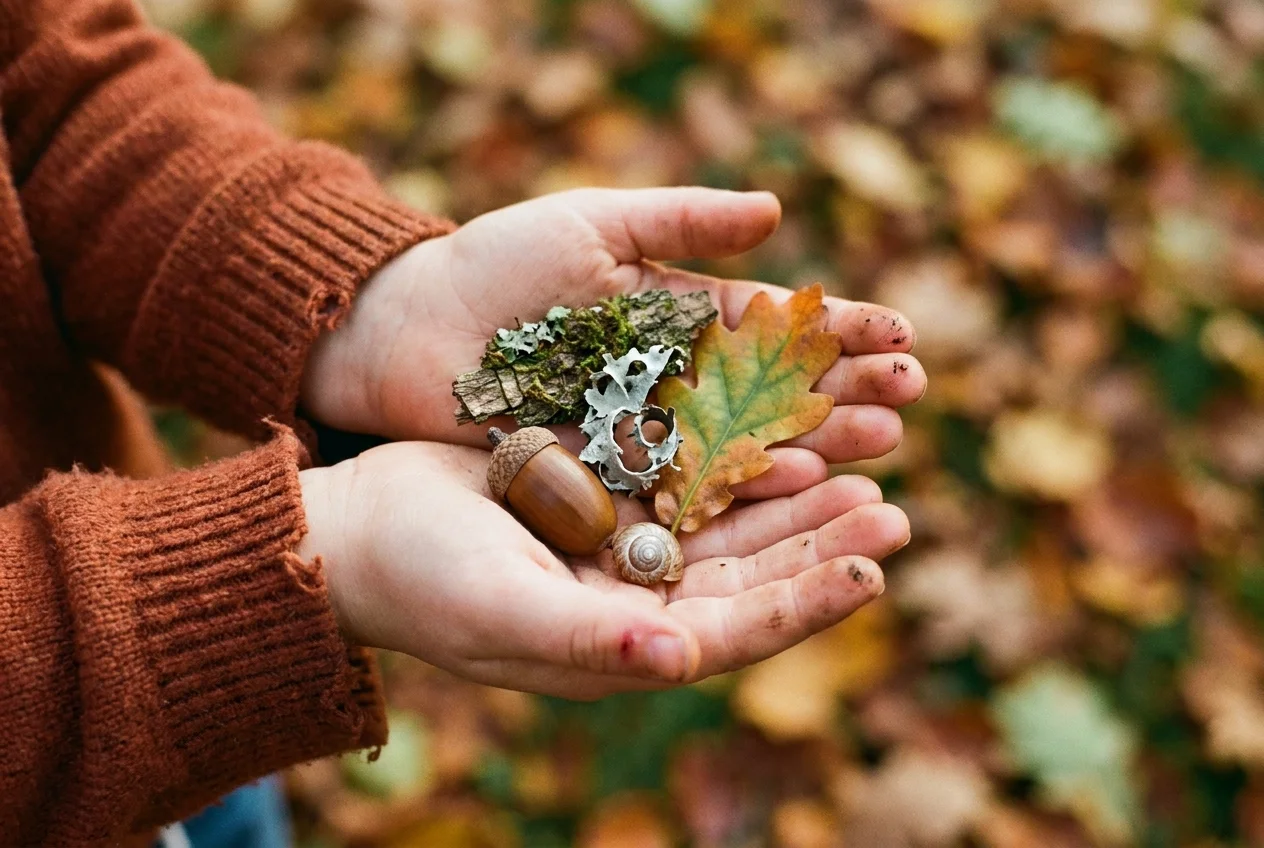
A printed list can't know it's frosty. A Peekabout hunt can. If the weather's set to Frosty the list might ask your hunters to spot ice on a puddle, a spider's web with droplets, a footprint in hard mud, a robin with puffed-up feathers. Those are real November things. A July printable will happily tell a six-year-old to find a bumblebee when there are no bumblebees to find, and a small person will notice.
Peekabout also calibrates to your hunters' ages. A four-year-old gets things they can genuinely find, bright colors, obvious shapes, things on the ground. A nine-year-old gets a list that makes them think harder: count three kinds of tree, listen for a woodpecker, find something that makes a noise when you crush it. The same family walk becomes a different hunt for each hunter.
A nature scavenger hunt is a list of things to find on a walk, structured enough to keep kids interested but not so rigid that it becomes homework. Peekabout's hunts mix several ways of finding:
Spotting. A heron, a cobweb, a particular kind of leaf, moss on the north side of a trunk.
Counting. Three kinds of tree. Five different bird calls. Two shades of green on one leaf.
Listening. A woodpecker drumming, a robin ticking, the rustle of something small in the undergrowth.
Touching. Smooth bark, rough bark, something cold, something sticky, wet moss.
Collecting, where it's sensible. A feather, an interesting stone, a pine cone, a fallen leaf you really like.
The mix changes per hunt. Dense woodland leans on listening and spotting. A beach walk leans on collecting and touching. A city park walk leans on observation: the one pigeon that doesn't look like the others, the tree with a name on the plaque.
Short lists of bright, obvious, close-range things. Something red, something soft, something with feathers, a leaf with five points, a bird that's bigger than your hand. Usually eight to ten items with a Short duration setting. The parent reads the clue aloud; the child spots. Pre-readers do fine.
Reading age is starting to catch up. Ten-item lists with slightly more specific prompts. An acorn with its cap on, a tree older than you are, something a squirrel might have nibbled, a feather. Spot, count, and touch in roughly equal measure.
Harder lists, proper species names, listening prompts, a bit of light identification. Two kinds of oak, a mushroom with white gills, a bird call you recognize. Older hunters often enjoy Challenge mode: the same hunt, against a timer, with a personal best to beat next time.
A blended hunt. Some items for the younger, some for the older. Siblings tend to help each other without being prompted, which is part of why this works as well as it does.
Specific examples, in case it's useful to know what we mean.
In a temperate woodland in fall: a horse chestnut still in its spiky green case, an acorn with the cap on, moss on the north side of a trunk, a squirrel drey high up, an oak leaf, a woodpecker hole, lichen on a fallen branch, fox prints in mud.
In a park in spring: a daffodil, a blossom petal on the path, a robin, the first leaves on a birch, a bumblebee on a dandelion, a pigeon sunning itself, a handful of crocuses, the name on a park bench plaque.
On a beach or coastal walk: a piece of sea-smoothed glass, a feather, a barnacle-covered rock, a cast shell, a line of high-tide debris, the bones of something small.
In a city or on a town walk: moss in sidewalk cracks, a cat in a window, the tallest tree on the road, a dandelion in tarmac, ivy climbing a wall, a snail on a garden gate.
Usually between eight and sixteen. Short hunts (for a 30 to 60 minute walk) are eight to ten items. Medium hunts (60 to 90 minutes) are ten to twelve. Long hunts for proper weekend expeditions are fourteen to sixteen.
There's a Custom option too if you want to pick the exact number, anywhere from four to twenty.
More than you'd think. Set the weather to Frosty or Snowy at setup and Peekabout leans into the season: tracks in hard mud or snow, frost on a puddle, skeletal tree shapes, evergreens, holly berries, a robin, rose hips, the shape of nests now visible through bare branches, the particular stillness of a winter wood.
Winter hunts are honestly among the best because the landscape is simpler and each find feels harder-won.
Yes, every hunt is freshly generated. The same biome and weather on a different day will give a different list. You're not playing the same hunt twice unless you ask for it (you can replay a hunt you've already done if you want to try it again).
Yes, from about two or three upward. For pre-readers the parent reads the clues aloud and the child spots. Peekabout calibrates the list to the youngest hunter's age, so a three-year-old gets short, clear, bright prompts and isn't asked to identify species.
Most families report that two and three year olds surprise them.
No. Most of the hunt is spotting, counting, and touching, not identifying. There's no quiz, no "did you get it right", no correct answers to memorise. Identification prompts only appear for older kids who Peekabout thinks can handle it, and even then they're framed as curiosity, not homework.
The point is being outside together, not passing a test.
See also: the scavenger hunt app in full, family walks across the UK, or the long-form help page.
Ready to peek about?
Try a free hunt in your browser →Live now on iOS and Android. $3.99, one purchase, yours for keeps.